Sustainability has become a strategic priority across industries, and companies are actively searching for ways to measure and reduce the environmental impact of their production processes. In additive manufacturing (AM), one of the biggest challenges remains obtaining accurate and accessible CO₂ data for individual components.
Responding to this industry‑wide need, a significant advancement came with the adoption of 3D Spark’s automated CO₂ footprint reporting platform, recently approved for use by Deutsche Bahn, one of Europe’s largest transport operators. The platform provides instant CO₂ calculations for AM parts, replacing slow and costly traditional LCA tools and enabling faster, compliant, and more sustainable production decisions. In practice, it streamlines workflows, reduces administrative effort, and supports smarter technology choices throughout the product lifecycle.
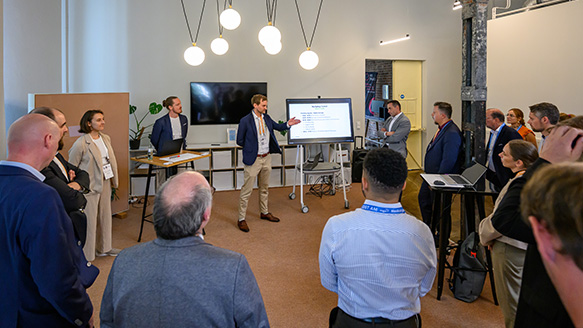
Workshop during MGA Annualmeeting 2025
To bring these capabilities closer to industry practitioners, Deutsche Bahn, Blue Production, and 3D Spark showcased the approach during a hands‑on workshop at the MGA Annual Meeting. In an interactive format, participants explored three core topics through live demonstrations:
- Automated manufacturability testing to quickly assess whether parts are suitable for AM.
- Make‑or‑buy decision support, guided by a Blue Production expert, helping companies decide when to produce in‑house or outsource.
- CO₂ reporting via a shared digital platform, using real plastic and metal parts to compare emissions across materials and processes.
Using a World Café setup, small groups rotated between expert stations, tested the software on shared or personal laptops, and discussed real rail-sector use cases with representatives from Deutsche Bahn. This format allowed participants to experience first‑hand how easily CO₂ emissions can be calculated and how digital tools can support more informed AM decision‑making in day‑to‑day operations.