
General
Building the bridge to 2030: our strategy for 3D printing in healthcare
3D printing has been changing healthcare for years. Patient-specific implants and instruments, anatomical models for surgical planning, production close to the patient, and new approaches in pharma and bioprinting are already delivering real value.
Yet too much of that change still happens in one case, one clinic and one printer at a time. Our Medical Strategy 2025 to 2030 exists to help move additive manufacturing in healthcare from a promising niche into reliable, regulated and repeatable production, and to accelerate adoption across European healthcare systems.
At the center of the strategy is something we have always believed in, namely community. MGA does not make implants or sell printers. Our value lies in connection, bringing the surgeon, the regulatory specialist, the engineer, the researcher, and the manufacturer around the same problem. A clinical adoption challenge, a regulatory question and a research gap are all, in the end, solved by the right people finding each other and staying engaged long enough to deliver. Build and sustain that community, and the rest becomes possible. Neglect it, and no roadmap survives in contact with reality. That is why community and sustainability is not one priority among many for us. It is the foundation everything else stands on.
From strategy to delivery
In January 2025 we convened a Strategic Committee of our medical members to define the direction for the next five years and turn it into something we could execute. That same body has since evolved into a Steering Committee, which now monitors implementation and holds our annual work programme accountable to the strategy. A strategy is the light that shows the path. Implementation is how we walk it, and we have built the structure to do both.
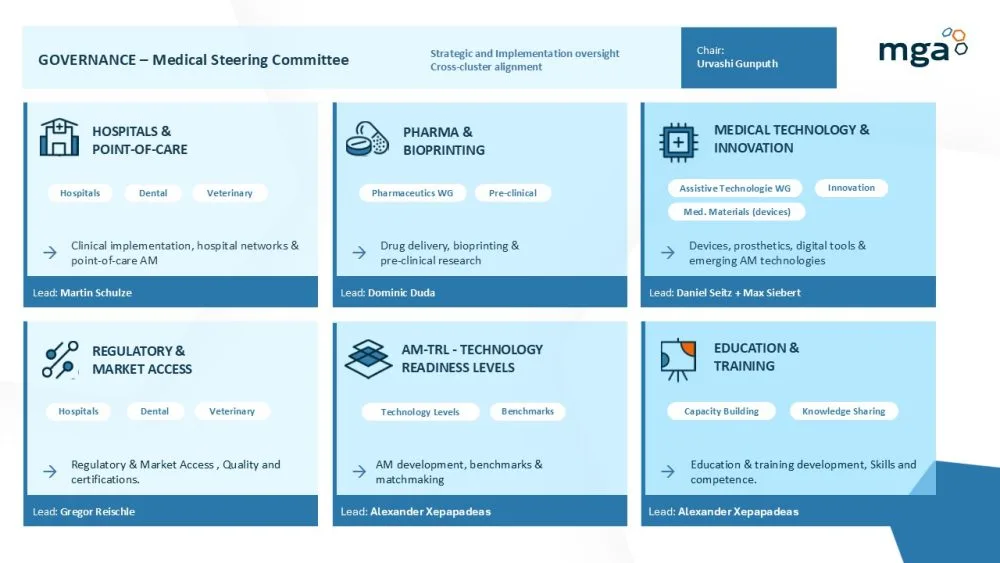
To deliver, we have organised our work into focused clusters that mirror how value is created. Three user and application clusters sit closest to the patient and the product: Medical Technology and Innovation, Hospitals and Point-of-Care, and Pharma and Bioprinting, the last spanning the full use of additive manufacturing across the pharmaceutical field, from manufacturing and diagnostics to tissue engineering and bioprinting. Three enabling clusters supply the cross-cutting capabilities the others depend on: Regulatory and Market Access, Education and Training, and AM Readiness Level. Each cluster is driven by a dedicated lead who sets its agenda and connects its work to the wider network.
The questions beyond printing
For us, technical feasibility is no longer the hard part. The harder questions are how to win regulatory approval, how to secure reimbursement across European health systems, and which business models make 3D printing in healthcare commercially sustainable. The economics of in-hospital point-of-care production differ sharply from centralized manufacturing, service bureaus or OEM service and licensing models, and each carries its own assumptions about volume, liability, quality and, above all, who pays. Working through these questions, and helping our members build the business case, is central to moving applications from clinically possible to commercially sustainable.
Help us build the AM Readiness Tool
One of the most tangible outputs of the strategy is our AM Readiness Tool, which we are building right now. It is based on an AM Readiness Level model that assesses maturity across many dimensions and tailors the picture to hospitals, medical technology companies, and the pharmaceutical industry. Because it is still in development, we are actively looking for experts across the medical AM field to help shape and complete it. If that sounds like you, we would love to hear from you.
This is how we intend to build the bridge to 2030: together, as a community, and out of the niche at last.
Join MGA, contact the healthcare team to support the AM Readiness Tool.